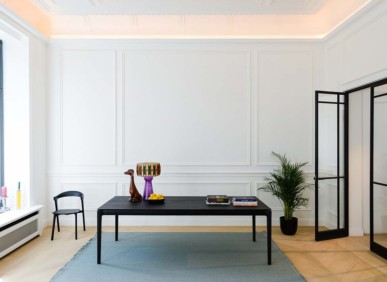
Flexible Lighting Cornice
Curved walls can be an impressive architectural feature, but fitting standard rigid coving around curved walls is very difficult. Flexible LED coving is made from a bendable flexible polyurethane material that can follow concave or convex curves without warping, cracking, or losing its shape. For more information on our materials, please click here.
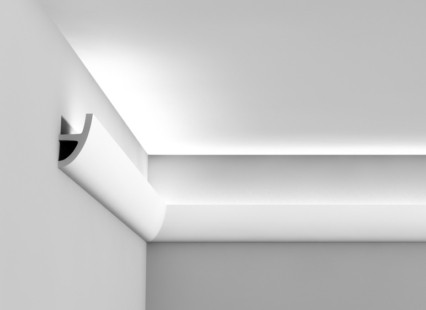
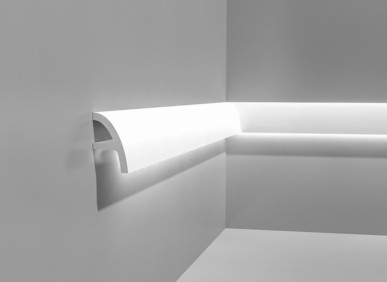
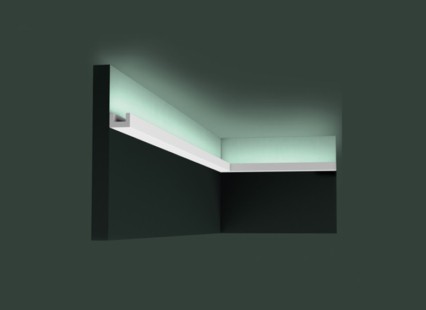
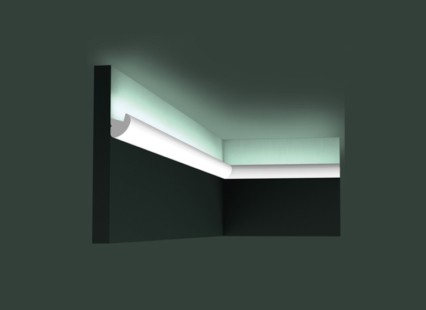
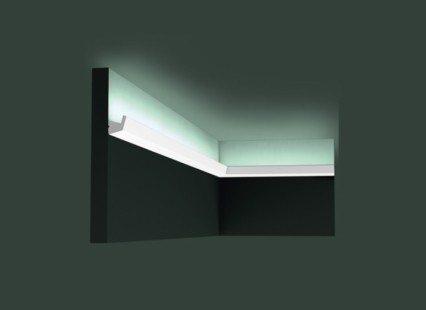
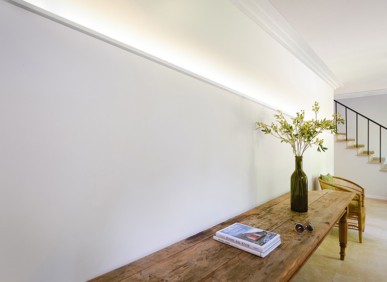
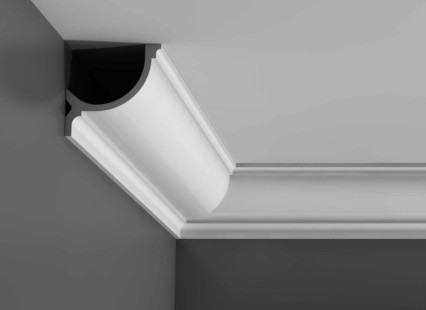
Flexible lighting cornice is typically used around bay windows, rounded walls, curved hallways, staircases and curved walls. It can also be used on ceilings where the ceilings are curved. These cornices are designed to conceal an LED strip or aluminium lighting channel, for indirect lighting and adding a new dimension to your interior.
For straight walls, view our full range of LED coving for curved walls where lighting is not required.
Benefits of flexible lighting cornice:
Flexible coving & flexible cornice bend to concave or convex walls. As beautiful as plaster.
- Perfect for bay windows. (The min. radius for each profile is quoted on it’s product page).
- Quicker and easier than cutting many joints in plaster.
- Light enough to be installed by one person. Perfect for DIY.
- Pre-primed surface requires only one coat of paint.
- Water/humidity resistant – suitable for use in bathrooms and kitchens.
- Material type: Flexible Polyurethane. Read about materials.
- Typical delivery in 1 to 3 working days.
- Price promise. Find the same product cheaper online in the UK and we’ll beat it by 5%.
Choosing the right flexible lighting cornice
The most important measurement is the minimum radius. This tells you how tightly the cornice can bend without becoming distorted or not being able to be fixed properly in position.
Each product page shows its minimum radius. A lower minimum radius means that the profile is more flexible and can bend to a tighter curve. The Smaller the cornice, the more flexible it becomes, our large cornices would be able to bend around large sweeping curves, not tight rounded corners.
It doesn’t matter if the cornice is bent concave or convex (inward or outwards) the flexibility remains the same.
Before ordering, you should consider:
- The radius of your curved wall
- How far down the wall you want the cornice positioned
- Whether you want uplighting or downlighting.
- The height and projection of the profile
- The electricity supply to the profiles for the LED strip.
Please see our guide on how to calculate the minimum radius of a curved wall before placing your order. if you need a hand calculating the minimum radius, please contact us.
Frequently Asked Questions:
How to install Flexible LED Coving?
Once its determined that the coving will bend sufficiently, installation is much the same as the standard LED coving, please see the installation guide here – Installing LED Coving.
A tip for installing the flexible profiles is the join them using the Fix Ultra Jointing adhesive the night before installation. This makes it easier to line the flexible profiles up neatly rather than trying to force the joins to match up during installation.
We don`t supply the LED lights so this will have to be done by a qualified electrician.
Can you paint flexible LED coving?
Yes flexible LED coving is supplied pre-primed and designed to be painted. We would recommend painting with a good quality, branded water-based paint. For a seamless minimalistic look, then paint it the same colour as the wall. If you want the coving to stand out and be noticeable paint it a contrasting colour to make it look like an obvious lighting rail.
What is flexible LED coving?
Flexible LED coving is a moulding which is bendable and can bend to the shape of curved walls for example going around bay windows and curved bar areas.
Are the LED lights included?
No it is just the length which is supplied, the LED strip or aluminium channel will have to be purchased seperatley.
Can it be used as a downlight cornice?
Yes absolutley, you can use all our LED covings as either uplight or downlight cornices. One point to bear in mind is that depending on the height of the downlight cornice, and where the LED is set, the LED strip may be visible so please bear this in mind if you don`t want to see the LED strip.
What does minimum radius mean?
The Minimum radius is the measurement for the tightest curve which the cornice will bend too. In simple terms, the radius is the measurement from the centre of a circle to the edge of the circle. It is not the diameter which is the width across the whole circle.
Can Flexible and Rigid cornice be used together?
Yes, they are exactly the same profile shape and size so will butt up to each other, it is just made from a different material. We would recommend ordering the flexible lengths only where required as they are about twice the price of the standard lengths.
Minimum Radius & Sizing Cornice
Calculate the radius of your wall first. This is critical as no flexible profile will bend to a tighter radius than the minimum we quote. For details on how to calculate your radius, call or click here.
For sizing, under each profile we show height (how far the cornice extends down the wall from the ceiling) & projection (how far it extends across the ceiling from the wall).
Installation Guides
Click for installation instructions PDF
Click for cutting a stop end PDF